
35 things I've learned in 35 years
Feb 05, 2026
Thirty‑five years ago, “teaching tech” meant floppy disks, beige computers, and classrooms full of people who were slightly afraid of the mouse. Today it means Teams, SharePoint, OneNote, online courses, and students joining from their kitchen tables. A lot has changed. A few things haven’t.
Here are 35 things these decades in the classroom, boardroom, and Teams or Zoom room have taught about helping people and organizations actually learn technology.
People, not programs
- People don’t really want to learn software; they want to get their work done faster and feel less stupid while doing it. The trick is to teach the program in the language of their day‑to‑day work, not in “button tours.”
- No one is actually “bad with computers.” Most people have just been rushed, talked over, or handed training that never matched their reality. When you fix that, confidence appears fast.
- The phrase “I’m just not techy” usually means “I don’t want to feel embarrassed.” A little kindness and a well‑timed joke will open more minds than any feature list.
- The people who say “I already know Outlook / Excel / Teams” are often the ones who leave saying, “I had no idea it could do that.” We truly don’t know what we don’t know until someone shows us.
- There is always at least one person in the room convinced the class will be a waste of time. Winning them over is one of the best metrics of a good session.
How adults really learn
- Adults don’t learn well when they’re being “performed at.” They learn when they’re asked questions, invited to try things, and allowed to be delightfully wrong without feeling foolish.
- Practice beats perfect demos every time. If students don’t get their own hands on the keys, they’ll nod politely, go back to their desks, and do everything the old way.
- “I’m a quick learner” is step one. Step two is using what you learned in real work within a few days, or it quietly evaporates. Follow‑up and coaching are not luxuries, they’re the learning.
- Bad training doesn’t just waste time; it creates training‑resistant people. One painful “scripted” class can turn someone off learning for years until they finally risk trying again.
- The length of the class is inversely related to how much people remember. Eight‑hour marathons create learners who are “asleep with their eyes open.” Short, focused sessions win.
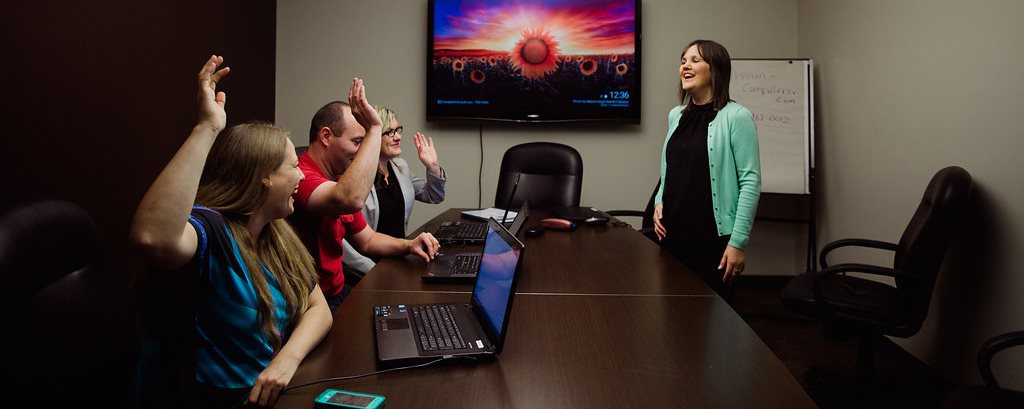
Why live humans still matter
- Books, Google, and YouTube are wonderful; but they aren’t teachers. They can give answers, but they can’t watch you work, see the pattern in your mistakes, or suggest a better path for your situation.
- People often say “I don’t need you, I have Google.” Until Google gives them 47 conflicting answers and they’re more confused than when they started. Experience trumps search results.
- A good tech teacher doesn’t just know where the buttons are. A good teacher knows where people will get lost, where they’ll panic, and how to walk them out of trouble calmly.
- Patience isn’t optional. Everyone learns at a different speed. If you rush learners to match your pace, they don’t learn faster, they just feel smaller.
- Encouragement is a tech tool. A genuine “You’re doing great; this part confuses everyone at first” can be the difference between someone giving up and trying one more time.
Classroom vs online (and why both work)
- In‑person training lets you read faces, feel the energy, and respond on the fly. That’s where many of the “I know exactly what story to tell here” instincts were born.
- Online training, done well, is not “less than” the classroom. Short lessons, replay buttons, and chat make it possible to learn in real life, not just in a hotel meeting room.
- People retain more when lessons are 10–15 minutes and built around real tasks. Bite‑sized beats firehose, especially when they can pause, rewind, and try it themselves.
- Cameras on or off, it’s still possible to engage people online. Questions, polls, and chat can create more interaction than some face‑to‑face sessions, if you plan for it.
- The best blend is often this: live coaching and Q&A wrapped around strong self‑paced lessons. Content teaches the “what.” Coaching unlocks the “how do we apply this?”

Change, resistance, and “what if?”
- The biggest barrier to new tools isn’t the software. It’s the story people tell themselves: “This won’t work for me,” “Online isn’t as good,” “We don’t have time to learn.”
- People don’t resist change as much as they resist confusion. When you show a clear path, remove jargon, and respect their time, most people are surprisingly willing to try.
- The question “What if?” is dangerous in the best way. “What if there’s a better way?” has pulled a business out of the revolving door of “same old” more than once.
- Sometimes the bravest learners are the ones with the biggest binders, leather books, or paper planners. Watching them joyfully retire those tools after a course never gets old.
- Teaching tech means modelling change yourself: letting go of “but I’ve always done it this way” and being willing to become a beginner again with new platforms and formats.
What organizations get wrong (and right)
- “We don’t have time for training; we have work to do” is the most expensive sentence many organizations repeat. They pay for the time anyway, just in slower, more frustrating work.
- Tool rollouts fail when training is an afterthought. They succeed when people are assessed, sessions are designed around their real jobs, and leaders actually show up to learn too.
- Sending everyone to an all‑day generic course and hoping for miracles is wishful thinking. Tailored, scenario‑based training pays off far more than “one size fits nobody.”
- The teams that thrive appoint “champions,” invest in their learning, and give them time to support others. Technology doesn’t spread by email memo; it spreads through people.
- When organizations treat training as a checkbox, they get checkbox results. When they treat it as a skill‑building journey, they get new habits, better systems, and happier staff.
What 35 years have confirmed
- Curiosity is a superpower. The people who ask “Why does it do that?” and “What else is possible?” become the go‑to experts, even if they didn’t start out confident.
- Teaching and learning are a two‑way street. Students bring real‑world problems that keep the teacher sharp; the teacher brings frameworks and shortcuts that keep students sane.
- Stories beat specs. A tale about a client who saved 20 minutes a day after one Outlook tip sticks in people’s minds far longer than a bullet list of features.
- Technology will always change. Human reactions to it, fear, excitement, overwhelm, relief, are much more constant. The job is to guide people through those reactions, not pretend they aren’t there.
- The biggest lesson of all: when people have the right knowledge, delivered in the right way, they stop merely “putting up” with technology and start using it as a genuine advantage at work and in life. That moment, that spark, is why the teaching never gets old.